Mayo 2026: Kobe and the Lesson in Managing Potential
By Padraig O'Donnell
21 September 2026 · 10 min read
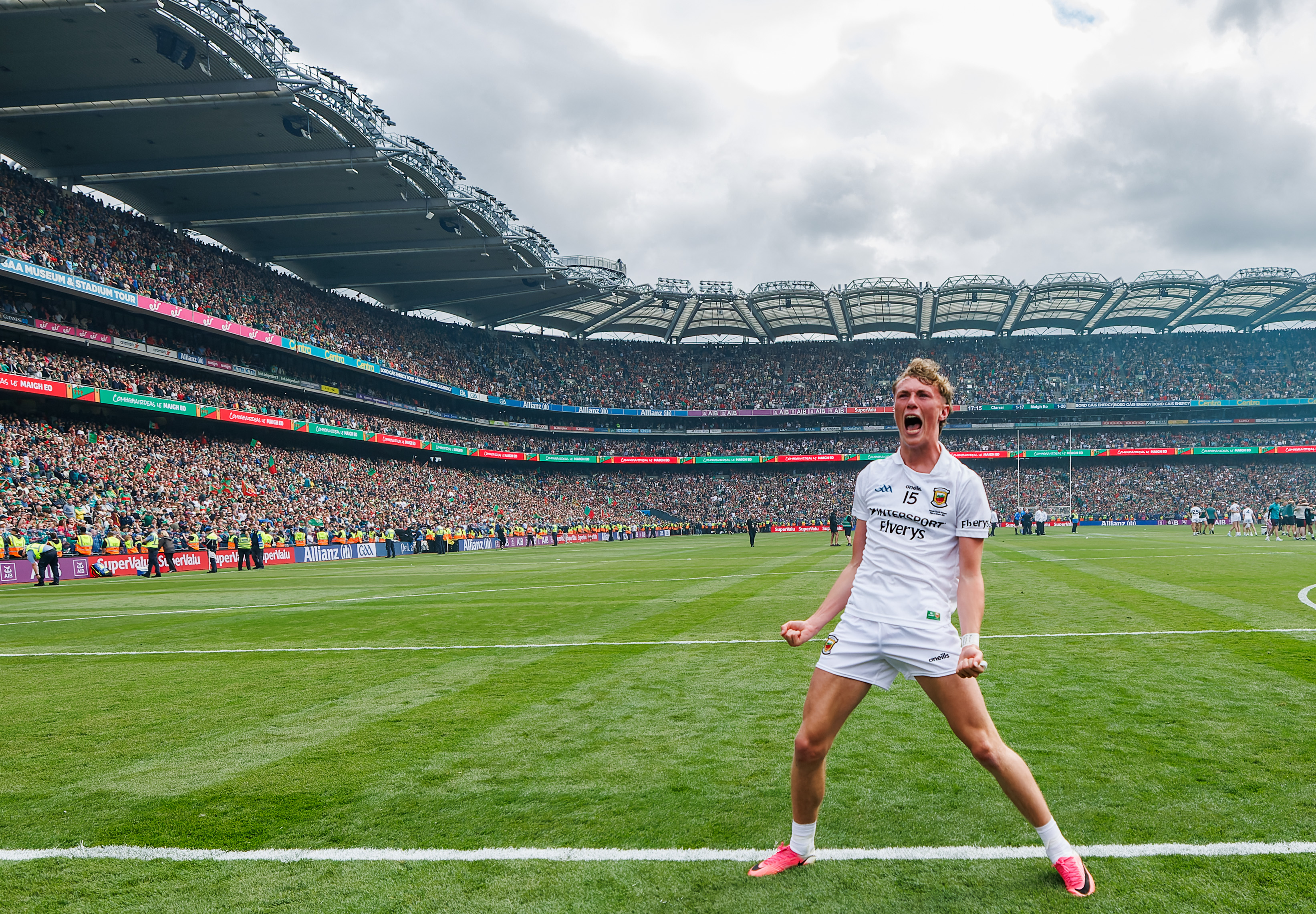
Credit: ©INPHO/James Crombie
Talent is easy to spot. Potential is much harder to manage.
We all enjoy seeing talent come through and wondering how far they might go. But there is a difference between what someone can do today and what we hope they might become tomorrow. The moment we treat potential as certainty, expectations can grow faster than the individuals development.
Thousands of articles have been written about talent management. We've all seen incentive models, graduate programmes, goal frameworks, scholarship programmes and academies built around the same idea: how do we give talented people the best chance of reaching their potential? The problem is that there is no simple formula. Give someone too little challenge and they may never develop. Push them too far and too soon and you can create problems.
Researchers such as Kristoffer Henriksen and Natalia Stambulova have explored the Athletic Talent Development Environment, highlighting the importance of the environment around talent. Cynthia McCauley’s work on developmental challenge showed how people can learn by being stretched, but the challenge needs to be appropriate to where they are in their development. Put the two ideas together and you get a simple concept: stretch the talent, don’t break it.
Ireland was introduced to a new star this summer. Kobe McDonald was only 18, still sitting his Leaving Cert when brought into the Mayo senior setup, and had already agreed a move to Australia to play for St Kilda in the AFL. In his first and potentially only season with Mayo, played a star role in Mayo ending a 75-year wait for an All-Ireland title.
It was a Roy of the Rovers story, and one that Hollywood could have a field day with in time. But as Kobe begins the next chapter of his professional journey, another exceptionally talented young sportsperson has been splattered across the back pages this week.
Fifteen-year-old JJ Gabriel is at the centre of a very different story at Manchester United. Both are exceptionally talented teenagers, but the real interest lies in what is happening around them.
MAYO AND THE 75-YEAR CURSE
For Mayo supporters, the 2026 All-Ireland final was historic. They had waited 75 years since the 1951 All-Ireland title, with eleven final defeats following. The so-called Mayo curse became part of Irish sporting folklore, and based around a story that the 1951 team had passed a funeral without showing respect and that a priest had cursed the county while any member of that team remained alive. The weight around it in Mayo had become very real.
Andy Moran was appointed Mayo manager in August 2025 and knew the implications, having experienced six All-Ireland final defeats as a player. He inherited an ageing team carrying the expectations and hurt of generations of players and his strategy was to turn to youth.
Moran said after winning the All-Ireland final that the younger players had “reinvigorated” the team, pointing specifically to their impact on the established players around them and Kobe McDonald was the fulcrum of that change for Mayo.
KING KOBE
Kobe was not exactly an unknown when he arrived in the Mayo senior setup. His father, Ciarán, had been one of Mayo's best forwards, playing in three All-Ireland finals against Kerry. Kobe had already made a name for himself through the Mayo underage system and had agreed a professional deal to join St Kilda in the AFL.
Moran introduced him into the senior setup when he was still a Leaving Cert student. The temptation with a talent like Kobe is to fast track them along with everything else around them. Kobe's talent was obvious and the hype around him grew quickly. Videos of his underage performances were everywhere and his name, given to him by his mother who had been a basketball player, only added to the attention. His surname also carried its own significance given his father was a Mayo star.
Moran gave him his opportunity, but resisted the temptation to throw him into the deep end. On his debut against Monaghan in February, Kobe came off the bench and scored 1-4 in less than 20 minutes. Moran's plan to ease him in slowly went out the window and the hype train did not so much leave the station that day as smash straight through it.
Keith Higgins, who was coaching Mayo’s Under-20s, pointed out that only two weeks earlier Kobe had still been playing schools football. The difference in physicality was enormous, yet Higgins credited Moran with easing him into the senior panel. Moran also allowed Kobe to continue playing Under-20 football, giving him space to remain playing with his friends while also being exposed to senior football.
The GAA environment also helped. Rules are that to play adult inter-county football, a player must be 18 before 1 January of the championship year. Kobe therefore had to progress through the normal pathway before senior football became an option. The structure helped control how quickly he was exposed to the highest level.
By the summer, Kobe was a star for Mayo and in the final his three points helped Mayo beat Kerry 1-20 to 1-17, ending the curse and the 75-year wait. Almost immediately after the final he was off to Australia to begin the next chapter of and his professional sporting career with St Kilda.
JJ’S WORLD
JJ Gabriel is operating in a different environment. You can't really compare GAA to top-tier Premier League football, but there are similarities in the environments around the two teenagers.
JJ joined Manchester United at 11 and was named the club’s Jimmy Murphy Young Player of the Year last season, becoming its youngest winner. He scored 23 goals for the Under-18s and marked his UEFA Youth League debut with a hat-trick. United had planned to include him in the squad for the recent EFL Cup game against Brighton, which would make him the club’s youngest-ever player. Instead, his camp formally asked the club to cancel his registration and he has not been considered for selection since with reports linking him with Barcelona.
For me there is more going on here than a teenager wanting to leave a football club, and we do not know the full reasons behind it. But the circus surrounding a player who has yet to kick a ball in senior football is what makes the story interesting.
YAMAL’S MOVED THE GOALPOSTS
Lamine Yamal has shifted the goalposts for young players. When Barcelona gave him his debut at 15, nobody knew exactly where it would lead. Within a year he was playing for Spain at the European Championship. At 16 he was the youngest player ever to appear at a Euros going on to win the tournament with Spain and then, at 19, he was a World Cup winner.
Yamal is an outlier, but outliers change what everybody thinks is possible, which can only be a positive. Once football has seen a teenager become an international star, the question around the next youngster changes. Instead of asking whether they are too young, people start asking when they will get their chance.
That matters for JJ because expectations for young players are no longer just based on what they are doing on the pitch or the developmental markers laid out by their coaches but on the achievments of other players at their age.
WHO GETS TO MANAGE THE POTENTIAL?
Whatever the circumstances, it is highly unlikely that a 15-year-old is driving all of the rhetoric, negotiations, commercial considerations and media attention surrounding his career. There are parents, representatives, clubs, scouts and the media, all with a view on what this talent could become.
In JJ’s case, his father Joe O’Cearuill, a former Ireland international, is also his representative. JJ was born Joseph Junior Andreou O’Cearuill but now goes by JJ Gabriel. Reports have suggested the family name was changed to Gabriel for commercial or brand reasons. If that is true, it is a little scary to think that a 15-year-old’s identity is already being considered through a commercial lens.
Kobe's parents are closely involved in managing his transition into professional sport. When he moved to Australia to join St Kilda, they moved with him to support him. A number of young Irish players making the move into the AFL have struggled with homesickness, so having his parents there gives Kobe a familiar support network adding to creating the optimum enviornment for success. St Kilda also allows him to return home when the AFL season ends and play for Crossmolina in the Mayo club championship. His employer, coupled with his parents, are all focused on making the transition into professional sport as easy as possible.
We don't know who is driving the decisions around JJ's career. But what has been reported raises the question about who actually controls the development of a young footballer in the modern world. Is it the club, the parents, the agents or a combination of all three?
The challenge for whoever it is need to make sure that the environment remains a safe place where the player's best interests are protected from the ever increasing outside influences.
STRETCH THE TALENT. DON’T BREAK IT.
McCauley’s research into developmental challenge shows how people can develop through bigger roles, responsibilities and unfamiliar challenges. Henriksen and Stambulova take the thinking beyond the individual, looking at the wider environment around the talent: coaches, teammates, family, education and culture. The challenge needs to stretch the talent, but the environment needs to support the development.
Max Dowman is an interesting example of what good looks like. Also at 15, Dowman had already made his Premier League debut and featured prominently off the bench in Arsenal's title run last season. Mikel Arteta has spoken about reviewing his development every six months, looking at the quality of his minutes and whether he needs to step back into youth football for regular game time while continuing to train with the seniors. The answer at a review might be more first-team football, youth football or a mix of both. Arteta understands that the opportunity should serve the player, not the other way around.
And that brings us back to JJ. Reports suggest he was due to make his first-team competitive debut in the EFL Cup against Brighton last week but the circus surrounding Gabriel has taken the story somewhere very different. His camp in the lead up to the game decided his progress wasn't moving quickly enough and stopped him training with the club, effectively pushing the nuclear button on time at Old Trafford and are now pursuing opportunities elsewhere.
Perhaps the expectation is that JJ should be following a Yamal-like trajectory. Only history will tell whether the JJ Gabriel story is one with an ending like Yamal, or whether his team should have taken a leaf out of the Dowman or Kobe schools of thought.
WALK BEFORE YOU CAN RUN
The same thing often happens in the business arena as what is happening with Gabriel. The minute an employee is identified as exceptional, the machine around them often starts thinking about the next promotion, the bigger role and the leadership potential. As humans, we can be so focused on where we might eventually get to that we forget to focus on what is needed right now to progress.
Kobe, Dowman, Yamal and JJ Gabriel are all different stories, but they highlight the very same challenge. Talent creates opportunities, but the environment created around that talent often determines what happens next and where that potentail ends up.
Management theory supports this idea that good management isn't about pushing exceptional people forward as quickly as possible. It is about knowing when to stretch talent, when to protect it and when to let it develop at it's own natural pace.
The lesson I have taken away from the last few months, looking at Kobe's development alongside what is playing out in real time in Manchester, goes back to a very simple saying.
It's often best to learn to walk before you run!
Blog by Padraig O'Donnell