Ireland vs South Africa: Farrell, Erasmus and the Need to Evolve
11 November 2026 · 9 min read
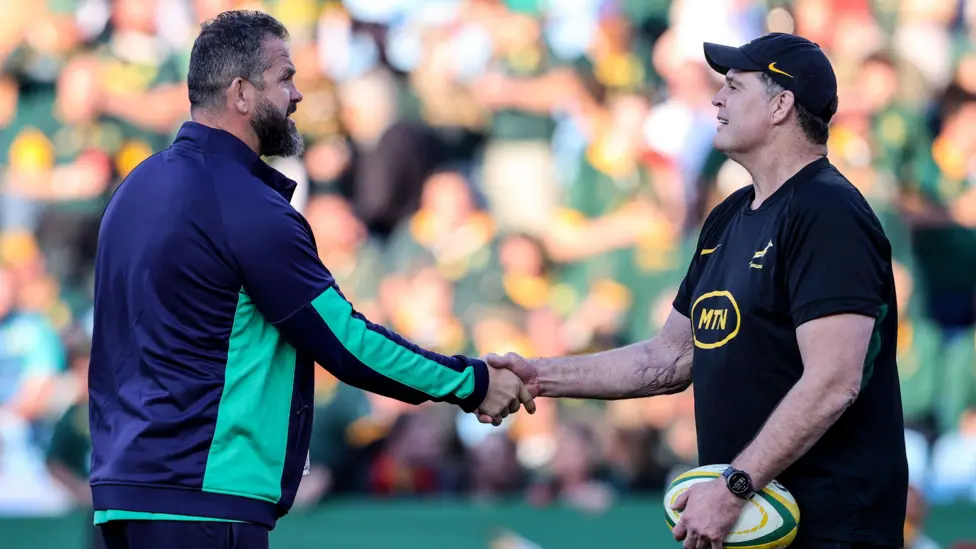
“We're always trying to evolve” – Andrew Goodman, Ireland Attack Coach
Andy Farrell and Rassie Erasmus are taking very different approaches to preparing their teams for Australia 2027. Are Ireland doing enough to challenge the way we play?
Evolution or revolution?
The November internationals have given us another opportunity to see where Ireland are as we build towards the 2027 Rugby World Cup. With South Africa also in action, I've been thinking about how differently Andy Farrell and Rassie Erasmus are going about it.
There has been plenty of discussion about Ireland's reliance on a group of experienced players, many of whom are now arguably in the twilight of their careers. But for me, the bigger question is whether Ireland are doing enough to evolve the way they play, rather than simply honing the way they've played over the last decade.
Ireland and South Africa's approaches remind me of the evolution of two familiar banks: Bank of Ireland and Revolut. I've banked with Bank of Ireland for years and used Revolut for quite some time. The Revolut experience is more intuitive, quicker and better suited to modern customers. The phrase "I'll Rev you" has even become part of everyday conversation when splitting a bill or sending money to a friend. One has spent years improving a model that works, while the other was built to do things differently, and that's not a bad way of describing Farrell and Erasmus.
There is a bit of management theory behind what I'm getting at. My UCD Smurfit thesis looked at the IRFU's transition from amateur to professional rugby between 1995 and 2010, and one of the ideas I came across during this work was organisational ambidexterity, which Michael Tushman and Charles O'Reilly wrote a lot about. In simple terms, it is about improving what you already do well while finding the time and space to try something different. You can't assume that what got you where you are will get you where you want to go next.
I think there is a version of that playing out with Farrell and Erasmus.
Rassie the rugby scientist
Rassie Erasmus has built a reputation for doing things a little differently, to say the least. In the years between World Cups, he has often come across as a wacky scientist, testing ideas, seeing what works and occasionally coming up with something that leaves the rest of the rugby world scratching its head. He seems to treat the sport's rulebook less as a set of rigid constraints and more as a framework for experimentation.
He can be credited with the "Bomb Squad", probably his best-known example. South Africa moved away from the traditional 5-3 split of forwards and backs on the bench. The strategy debuted at the 2019 World Cup with six forwards and just two backs, helping to demolish the England pack in the final. In 2023, they took this even further with a 7-1 split, leaving just one back in reserve.
There have been many other examples, from hybrid players who can cover multiple positions to different ways of using the lineout maul in open play. Whether he is flashing coloured lights from the coaches' box or transforming specialist flankers into emergency hookers, his approach often sits outside conventional rugby thinking.
The lights are a good example. Back in his days coaching the Cheetahs, Erasmus used lights from the stadium roof to send messages to players on the pitch. The idea reappeared at the 2023 World Cup, where stadium noise made communication difficult, giving a visual way of relaying messages about injuries and substitutions. It might look a bit nuts, but there was a practical purpose behind it.
Not everything works, and not every idea will become a permanent feature of the Springboks' game. But that doesn't seem to put him off trying. Rassie's strength is his willingness to experiment while others stick with what they know.
Farrell's Ireland
Farrell has taken a less revolutionary route than Rassie. He inherited a relatively successful Irish team from Joe Schmidt and has largely built on what was already in place. He has introduced plenty of new players, with 24 debuts since the quarter-final defeat to New Zealand at the 2023 World Cup.
That's not a million miles away from Erasmus, who has capped 25 new Springboks since the final.
But there's a fair question about how much Ireland have refreshed the team. With Australia 2027 less than a year away, the latest squad shows Ireland are still heavily reliant on many of the same players who were central to the team in 2023. Robbie Henshaw, Gary Ringrose, Josh van der Flier, Tadhg Furlong and Jamison Gibson-Park are obvious examples. These are proven performers, but they are now in their early to mid thirties.
I'm not suggesting you discard experienced players, but there is a difference between having experienced players in your squad and being heavily reliant on them because alternatives haven't had the chance to develop or just aren't there to be selected.
And we don't have to look far to see how quickly those concerns can become reality. After just one game of this November series, Ireland's squad depth is already being tested by a handful of injuries. Gus McCarthy, the Leinster third-choice hooker, has been called into the squad days after being released by Leinster to play for UCD in the amateur All-Ireland League. Granted, McCarthy has been capped seven times by Ireland, but it shows how thin Ireland's options can get.
Ireland have enjoyed plenty of Six Nations success under Farrell, including two championships, but that success hasn't translated into World Cup progression. Ireland have never made it beyond the quarter-final. Winning the Six Nations is a significant achievement and financially important to the IRFU, but it doesn't mean the same approach will deliver a World Cup.
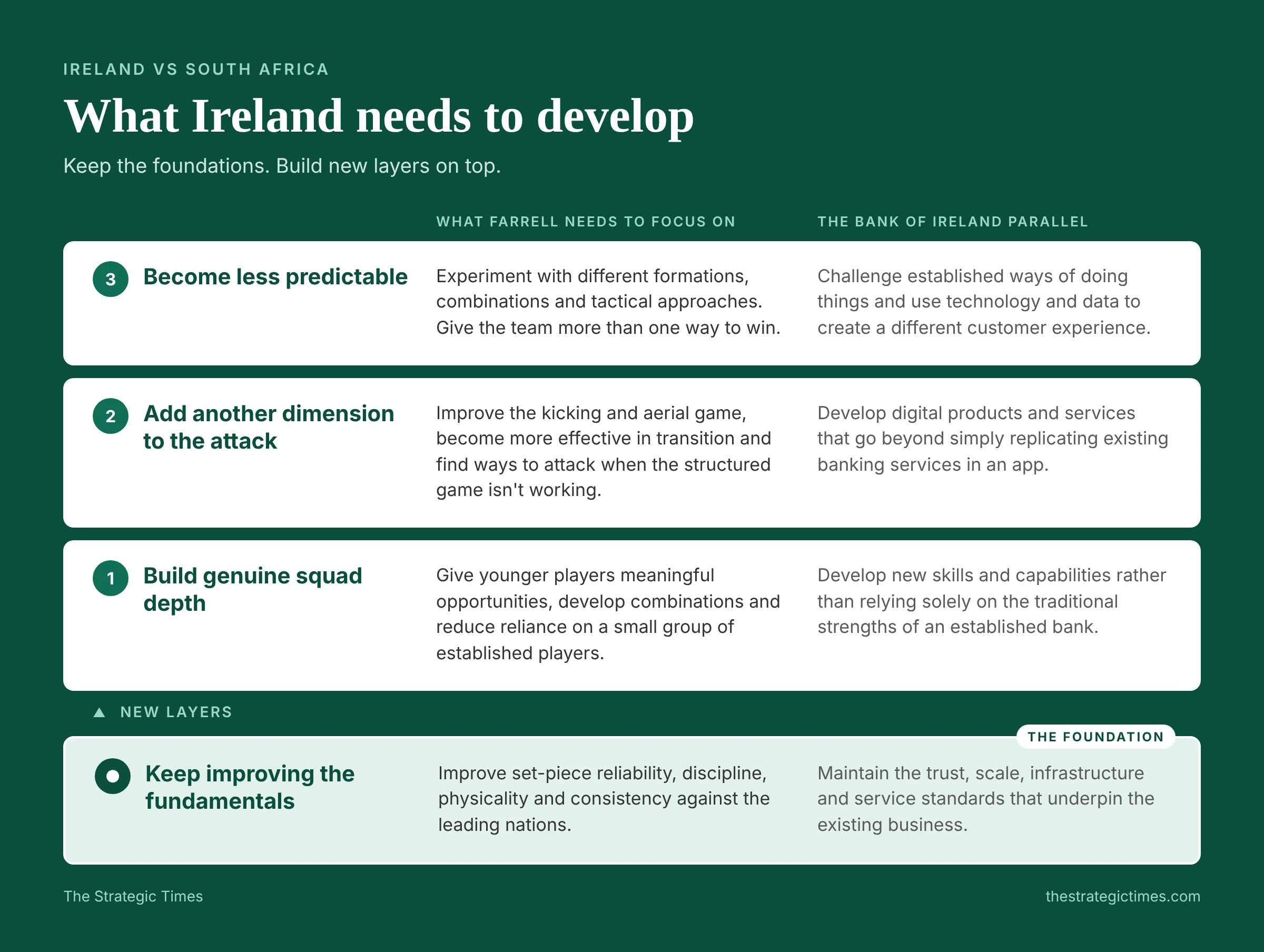
For me, the bigger difference between Farrell and Erasmus is not how many new players they have brought through, but how willing they have been to evolve and add more facets to the way their teams play.
Farrell has largely backed the Irish blueprint that brought him success, building competition for places and improving how Ireland execute their game. Erasmus, meanwhile, has been prepared to question the blueprint itself, experimenting with different formations, selection strategies and ways of playing the game.
In fairness, Ireland's attack coach Andrew Goodman recently said: "We're always trying to evolve." I'm sure that is the case, but I wonder whether Ireland's evolution has been more about refining what we already do well, rather than challenging some of the assumptions behind it.
Bank of Ireland and Revolut
Bank of Ireland has been wrestling with the same question. It and Revolut are competing in the same market, but they have come at it from very different starting points.
Bank of Ireland is an established institution with a huge customer base, legacy systems and a long history. It has to modernise while keeping millions of customers and the trust that comes with being an established bank. Its redesigned mobile app and appointment of its first Chief AI Officer are examples of how it is introducing new capabilities into an existing business. But what feels revolutionary for Bank of Ireland may already be part of the day-to-day capabilities of a business like Revolut.
Revolut, on the other hand, was built around a digital-first model. But as it has grown, its challenge has changed. It is no longer just about offering a slicker banking experience. It also has to establish itself as a credible banking institution.
That is reflected in its decision to put the word Bank into its branding, moving from simply Revolut to Revolut Bank. It might seem like a small change, but it says something about how the business is evolving. Having built its reputation as a challenger to traditional banks, it now wants to be recognised as a bank in its own right. Even the challenger has to get the basics right.
In rugby terms, Ireland look a lot more like Bank of Ireland: a successful, established model that is adding new capabilities to what it already has. South Africa are taking the Revolut approach of constantly looking for new ways of doing things and moving the goalposts for everyone else to try to match.
We have been here before
What struck me when researching my thesis was that going professional wasn't simply a case of paying players and carrying on as before. Irish rugby had to rethink how it operated.
The provinces needed professional structures. The IRFU had to invest in academies, coaching, facilities and player development. The centralised model helped keep leading Irish players playing at home, while creating a pathway from underage rugby through the provinces and into the national team. That helped create the foundations for the success we have enjoyed over the past two decades.
Farrell has strong foundations to work with, just as the IRFU did when professional rugby arrived. We know we are in a position to compete with the traditional powerhouses, which wasn't the case 20 years ago. But foundations alone won't get the job done at a World Cup.
Ireland may not need to reinvent everything, but I would like to see Farrell add a few more strings to our bow tactically, give us different ways of playing and keep the opposition guessing before we arrive in Australia.
Finding a different gear
I often think rugby at the top level is turning into Formula One. The top teams in the professional era all have talented engineers, data and highly skilled drivers, so on any given day, with a bit of luck, anyone can beat anyone. In sport and business, doing the same as your competition, just a little better, often isn't enough. Sustained success needs a point of difference, and sometimes moving the goalposts altogether.
If you keep giving opponents the same pictures, they can prepare for them. Heading into the World Cup, Ireland need to give teams like South Africa, France and the All Blacks different pictures, make them adjust and react, and keep them guessing.
I don't think Ireland need to become South Africa, or copy every Rassie experiment, or reinvent the game. Ireland have the foundations now to compete with the best, but the challenge is to build new layers on the game plan we've honed over the years. I think Ireland have the players to do this, with exciting talents like Mack Hansen, Robert Baloucoune, Dan Sheehan and Ryan Baird in the line-up.
Tushman and O'Reilly's study explained that success can breed comfort, and comfort makes it harder to change. Ireland need to keep doing what they do well, but find the time and space to try something different too.
The time to evolve is while you're winning, not after you've lost.