Loss Leaders: IRFU Should Think Turkeys, $2 Hot Dogs and Follow the Falcons
20 November 2026 · 11 min read
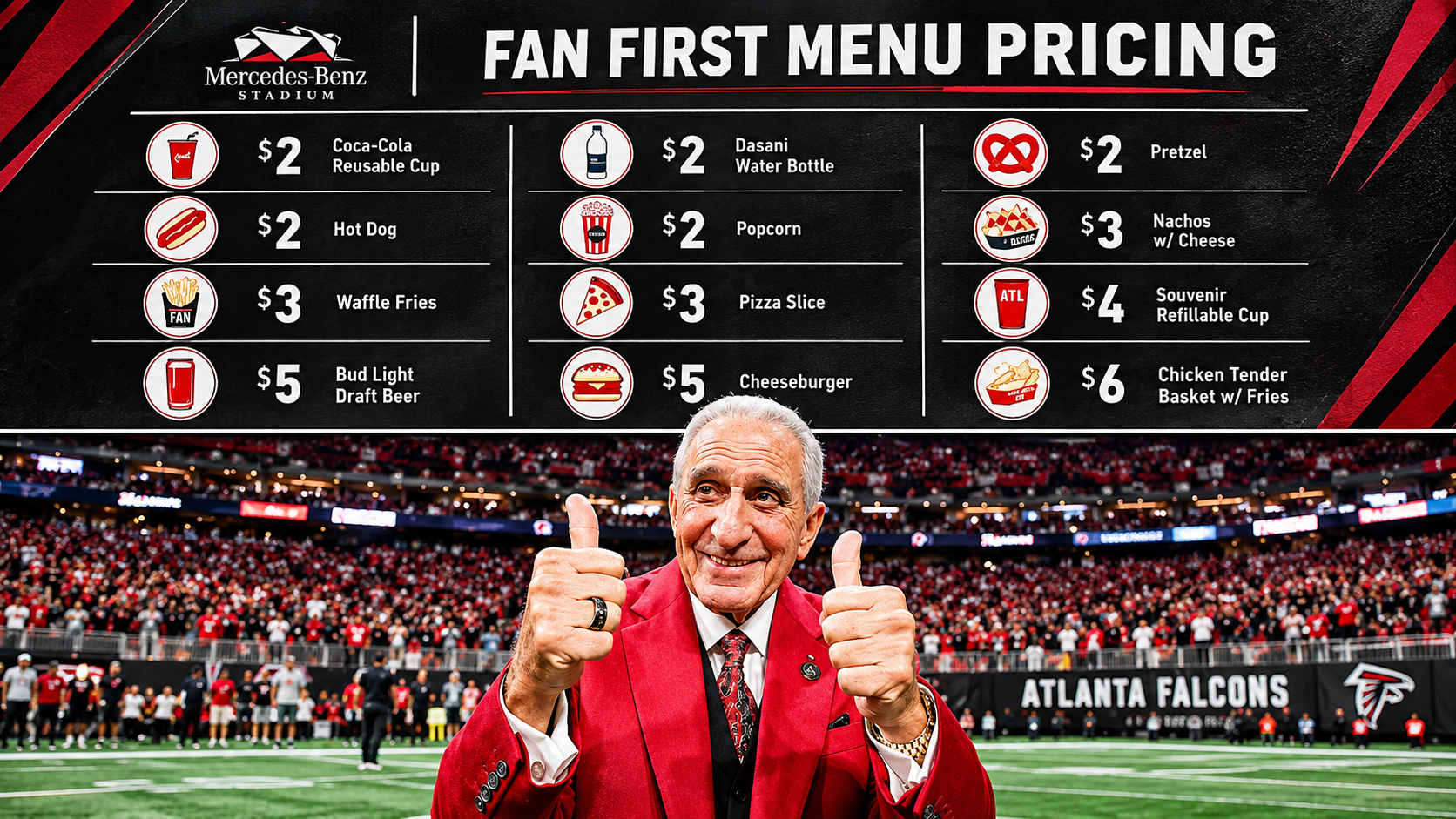
"I think 145 quid a ticket is pretty lumpy... The IRFU are making a mistake in overpricing these November matches."
Andy Dunne, Off The Ball, November 2026
What a couple of weekends of rugby we've had, and it's all building up to what should be an epic game at the Aviva tomorrow between Ireland and South Africa. There are so many subplots leading into the game. Andy Farrell has named his captain, Dan Sheehan, at number eight instead of his usual spot at hooker, which I think is brave, as it gives the Springboks a different picture to prepare for and maybe gives us some additional depth going forward. Then there's the ever-mercurial Rassie Erasmus, banned for six games over his comments during the week and now hosting a watch party for the match instead. But there's one subplot that has run through the whole week which is ticket pricing.
Talking turkey
Funnily enough, it was Christmas turkeys that got me thinking about this article. I read a piece in The Grocer recently covering Asda's approach to Christmas turkey prices. Asda has knocked 40% off its large British turkey, even though the price supermarkets pay for fresh birds has actually gone up.
Between my involvement with my local club, Terenure, and commentating on AIL games at Lakelands, I spend a lot of time around rugby people, and lately the talk keeps coming back to the price of a ticket rather than who is in the back row or who should be wearing ten.
Listening to Andy Dunne and Gerry Thornley debate the IRFU's ticket pricing on Off The Ball recently, Dunne made the point that tickets used to go like hot cakes, but now there are spares doing the rounds on WhatsApp groups which is something I've seen myself. This week I was offered tickets to the game on three separate occasions which I turned down.
Empty seats at the Aviva
The Aviva not selling out for Argentina was very unusual. It’s been full for most November games for years, but this time there were a couple of thousand empty seats. Would you pay €145 to watch Argentina at ten past eight on a Friday night in November? I wouldn’t. Myself and my good pal Des turned down two free tickets and watched it at home. Fiji the following Saturday was little better in terms of price but there were close to 6,000 empty seats even after the IRFU cut the price of adult tickets during the week.
As a lifelong, die-hard rugby supporter who used to try and get to most of the internationals, I'm now priced out of going to them all. Three games, a few pints and a bite to eat, and a taxi in and home would set me back close to a grand, the price of a trip away with the family. I said it on The Inside Line on Midlands 103fm last Sunday and I'll say it again here: the IRFU aren't reading the room.
I’ve a real soft spot for the IRFU, and my UCD Smurfit thesis looked at how it managed the move from amateur to professional rugby. Chief executive Kevin Potts said last year that “we have to charge prices that fill the stadium and deliver the revenues we need.” With men’s internationals bringing in around 80% of the union’s money, I understand why. But Potts also rejects the idea that home Tests have become a corporate day out, and I’d disagree. The grassroots fans have been replaced by corporate junkets, some of them spending a bit too long at the bar giving the work credit card a good workout.
A beer on the beach
So why would a supermarket happily lose money on a turkey, while the IRFU holds firm at €145 and watches seats go empty? Given my day job is in pricing, I went digging to see what the theory says, and whether there's anything the IRFU could borrow. It comes down to three ideas: loss leaders, feeling like you got a good deal, and whether a price feels fair.
Loss leaders
What Asda is doing with the turkey is a classic loss leader: selling something at or below cost because of what else it gets you. I was lucky to spend time at Circle K, a business obsessed with value for the customer, and we had an always-on meal deal, a hot drink and a sausage roll for €5. People buy those every day, so any discount you give away, you give away every time someone walks in, and the deal has to protect margin. The turkey is the opposite. Every house buys one, once a year, and you can’t exactly stockpile them in the freezer drawer. The supermarket knows exactly how much it can lose, and gets the biggest shop of the year in return.
Feeling like you got a good deal
Richard Thaler explained why that works with what he called mental accounting. His famous example was a cold beer on the beach: people would pay more for it from a fancy hotel than a run-down shop, even though it was the same beer. The Irish version is grumbling at €8 a pint in your local, then handing it over without a second thought in the Shelbourne.
Pick up a big bird for £21 when you expected to pay £35 and you walk around the rest of the shop feeling like you’ve had a result, not looking too closely at the price of the Baileys. It works the other way too. If you remember a Fiji ticket costing €35 ten years ago, paying €95 now feels like a bad deal before a ball is kicked.
Is it fair?
Thaler, Daniel Kahneman and Jack Knetsch also found that we'll accept paying more when costs go up, but it feels unfair when a seller is just cashing in on demand. Remember the Oasis tickets for Croke Park? Advertised at €86.50, they were selling for €415 a few hours later thanks to Ticketmaster's dynamic pricing. The IRFU doesn't use dynamic pricing, but it feels like they're doing the same thing, just more slowly, charging what they can get away with rather than what a day at the Aviva is worth.
What the numbers say
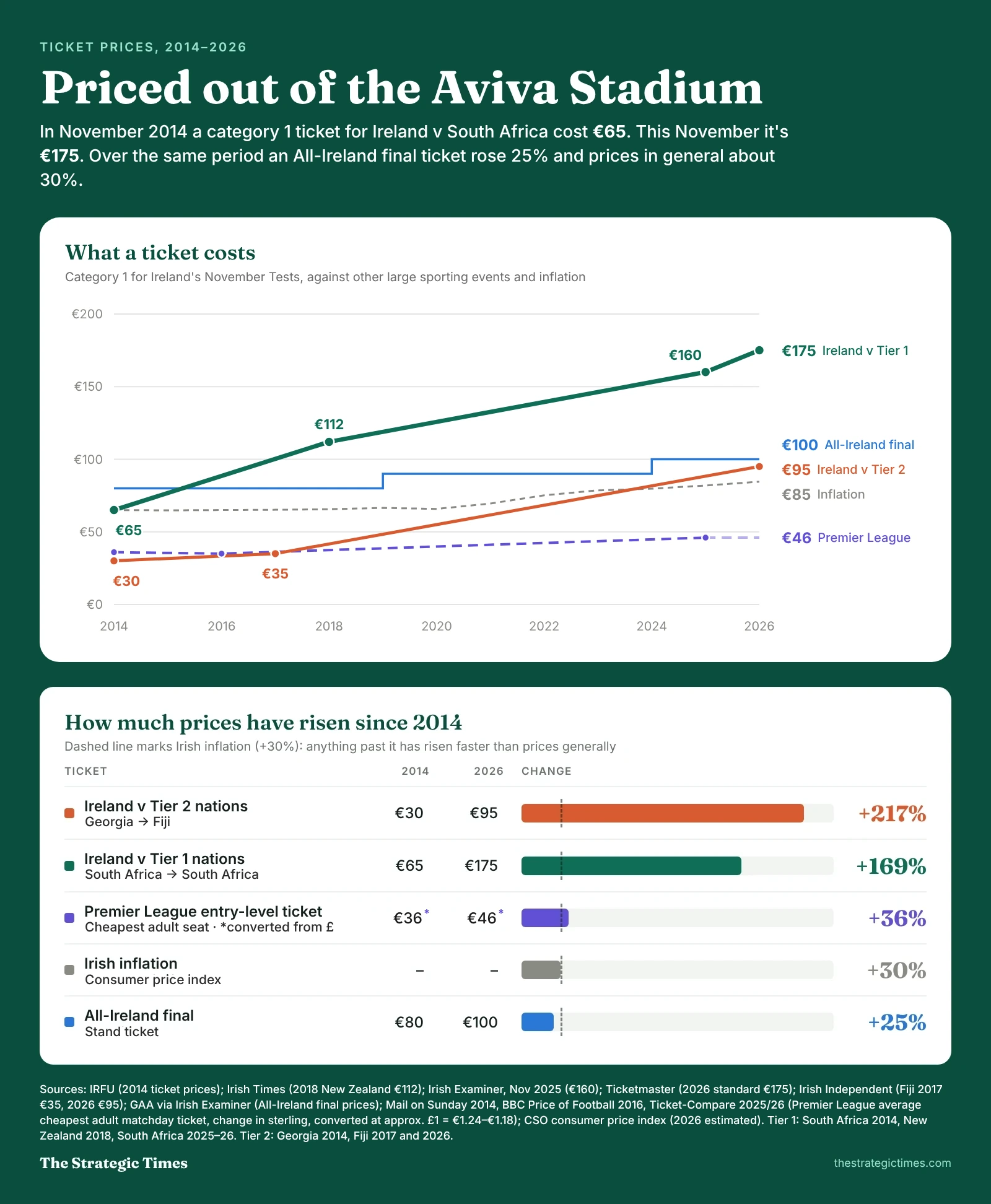
The jump is hard to ignore. In November 2014 a category 1 ticket for Ireland v South Africa cost €65. This coming Saturday it’s €175. I’ve mapped it against an All-Ireland final stand ticket, the Premier League’s cheapest adult ticket and the rate of inflation.
In the table below, anything past the grey dashed line has risen faster than inflation. The All-Ireland final hasn’t, and the Premier League has barely crept over it. Both Ireland tickets are miles past it, with Tier 2 games up more than 200%.
I’ve always thought the GAA get this right. A tenner or €15 gets you into most games, and you can bring the whole family for 50 quid.
Two dollar hot dogs
The IRFU aren't the first sporting organisation to have to think about how they price their events, and they won't be the last. My research led me to the Atlanta Falcons. A piece in Sports Business Journal explained how they used some creative thinking and a clever pricing strategy to make sure fans felt they were getting value on a match day. When they moved into their new stadium in 2017, they did something similar to the supermarkets:
- The Falcons made a decision to cut food and drink prices by around 50%, with $2 hot dogs and $5 beers.
- They took control of the pricing themselves, rather than leaving it to the caterer, so they could decide what a fair price looked like for fans.
- They kept ticket prices where they were, accepting they'd lose money on the food and make it back on tickets, sponsorship and fans spending more around the stadium.
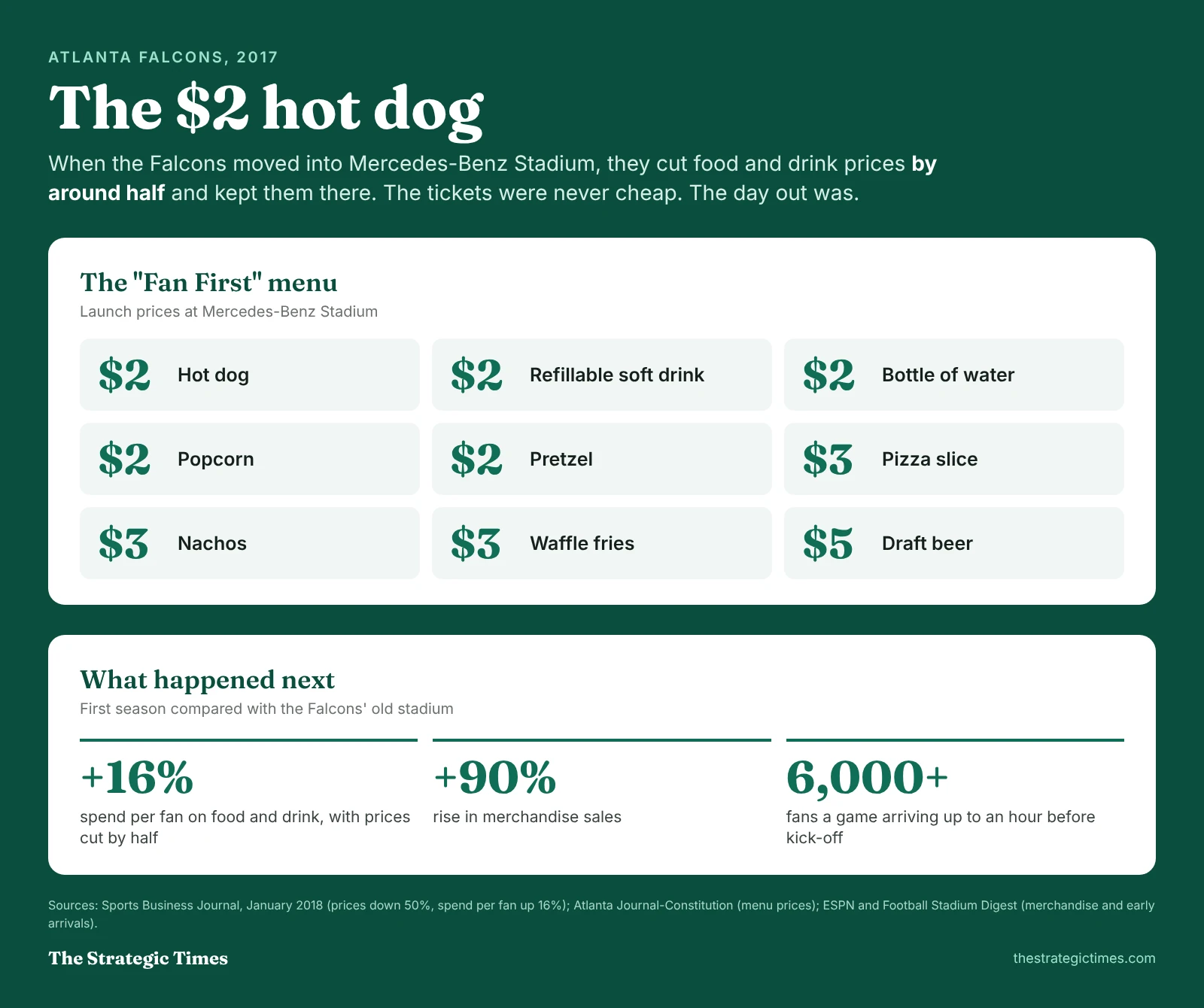
The results were positive. The Falcons saw fans spend 16% more on food and drink, even with prices down by half. Other reports have since put the rise in merchandise sales at 90%, with more than 6,000 fans a game coming in up to an hour before kick-off. The $2 hot dog was the Falcons' turkey. Nobody went to the game for it, but it changed how people felt about everything else they paid for that day.
Taking a leaf from Atlanta's book
I'm not suggesting the IRFU slash ticket prices. They simply can't, as international rugby funds the running and development of the game in Ireland. What they need to be careful of is alienating the average, run-of-the-mill rugby supporter and pricing them out of going to games altogether. If I was sitting in on their pricing discussions, I'd be pushing them to take three leaves out of Atlanta's book.
1. Find your hot dog
For the IRFU, that’s the less glamorous games. Argentina and Fiji will never sell themselves like South Africa or England, so stop pricing them as if they will. Make them a family or group night out, with a ticket to match, and bring in people who wouldn’t normally go. At Terenure, we let kids in free for select games if they’re wearing a club jersey, about as simple a turkey as you’ll find.
It’s not only amateur clubs who get this. After protests from their own fans, Manchester City sat down with their supporters’ group and cut matchday prices by up to 43% last season. If one of the biggest clubs in world football can listen to its fans, so can the IRFU.
2. Take control of the food and drink
The Aviva is run jointly with the FAI, so the caterers would need to be on board, but Atlanta showed it can be done. Arthur Blank, the Falcons owner, apparently took the idea from the Masters, where a pimento cheese sandwich still costs $1.50. Plenty of brands want to be associated with Irish rugby too, and the IRFU could get them competing to give fans the best value on the day, from a free burger with every ticket to cheap food before kick-off.
3. Give the kids memories that bring them back
Dortmund, the German football club, charge €18.50 to stand on the Yellow Wall, a terrace of over 24,000 fans behind one goal. It’s the cheapest part of the ground, and it’s where the atmosphere comes from. At Terenure, we pick one fixture a season as a family day, with bouncy castles and face painters. The IRFU doesn’t even need to look that far. Its own provinces already run fan zones that make a game about more than the 80 minutes, and are perhaps just further down the road than Ireland. Do the same for Fiji on a Saturday night and the kids who come are the ones buying Six Nations tickets in ten years’ time. I was one of them, standing with my Dad in the Havelock Square end in 1999.
Back to the turkey
Andy Dunne was right, €145 is lumpy but the IRFU's problem isn't really the price, it's the value. Thaler's study explained that people don't just look at what something costs, they ask whether it feels like a good deal. Asda gets that with a turkey, and the Falcons got it with a $2 hot dog. Right now, a day at the Aviva doesn't feel like a good deal for me and this is the reason I will watch the match this weekend at home or I might even accompany Rassie at his watch party.
The supermarkets only need the turkey to be cheap once a year. The IRFU needs fans coming back every season, and filling the stadium might just start at the food stands rather than the ticket office.
Sources and further reading
The story
- Christmas turkey prices drop as supermarkets battle on price, The Grocer
- Andy Dunne and Gerry Thornley on IRFU ticket pricing, Off The Ball
- IRFU defends ticket prices and rejects home internationals have become 'corporate day out', The Irish Times
- Ireland team: update on Aviva Stadium ticket sales, Planet Rugby
- IRFU Financial Report 2024/25, IRFU
- Dan Sheehan named at number 8 for Ireland's Springboks clash, RTÉ
- World Rugby statement: Rassie Erasmus banned, RugbyPass
Pricing elsewhere
- How the Falcons' fan-first pricing paid off, Sports Business Journal
- Oasis tickets controversy: is dynamic pricing any better than touting?, The Irish Times
- Manchester City ticket update, Manchester City
- Ticket prices, Borussia Dortmund
- How a cheese sandwich at the Masters is still $1.50, NPR
The theory (one-page summaries on The Strategic Times)
- Mental Accounting and Consumer Choice, Richard Thaler, 1985
- Fairness as a Constraint on Profit Seeking, Kahneman, Knetsch and Thaler, 1986
- Why Don't Prices Rise During Periods of Peak Demand?, Chevalier, Kashyap and Rossi, 2003
Also on The Strategic Times
- IRFU ticket pricing on The Inside Line, Midlands 103
- Strategic Renewal: The Case of the IRFU, my UCD Smurfit thesis
Ticket price sources are listed beneath the chart.